


Plumbing and HVAC Access Panels: What to Use Behind Walls and Ceilings Posted by Acudor Access Panels on 6th Nov 2026
Behind finished walls and ceilings, the right access panel is sized for the work, suited to its location, and sealed when the space demands it. Getting it wrong means cut drywall, stalled inspections, and technicians who can't reach the valve.
In this article, we'll cover planned access, wall versus ceiling selection, costly mistakes, sealed panels, and what to check before you order.
Why Do Plumbing and HVAC Systems Need Planned Access Behind Walls and Ceilings?
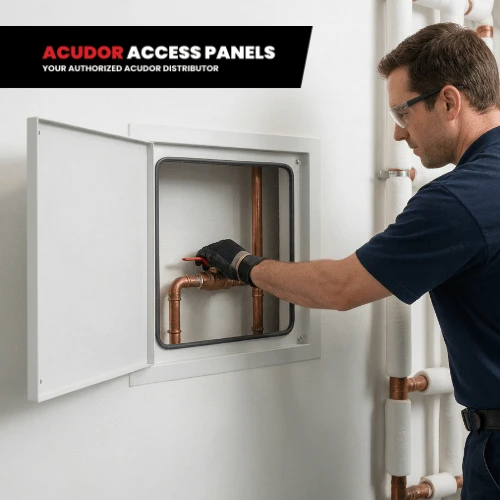
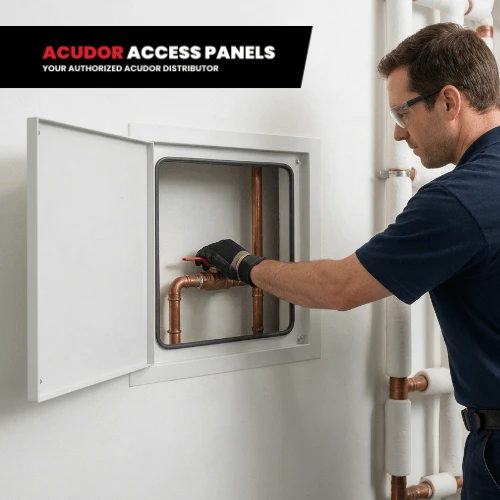
Plumbing and HVAC systems need planned access because their control parts must be inspected, adjusted, and replaced after the finish goes on. Plumbing and HVAC access panels keep those parts within reach without cutting into the wall or ceiling.
On the mechanical side, International Mechanical Code (IMC) Section 306.1 calls for appliances to be reachable for service without removing permanent construction. On the plumbing side, access panels for maintenance follow the adopted plumbing code and fixture instructions. Check local requirements with the authority having jurisdiction.
Plumbing Service Points
Plumbing access panels, also called plumbing access doors, typically serve:
- Shutoff and isolation valves: Closed before every downstream repair.
- Mixing valves: Adjusted for outlet temperature and serviced when cartridges wear out.
- Pipe joints, cleanouts, and backflow assemblies: Inspected for leaks, cleared, or tested on a schedule.
HVAC Service Points
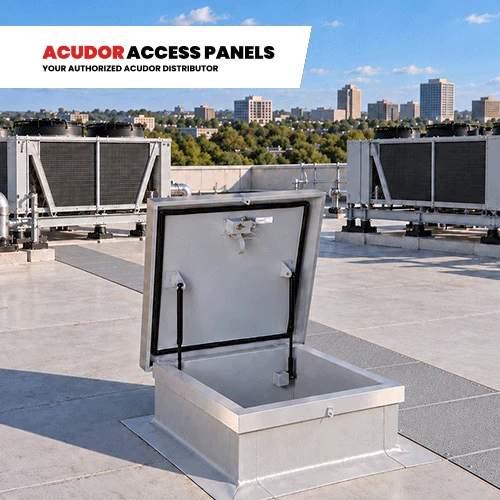
HVAC access panels typically sit near ductwork above ceilings:
- Fire, smoke, and balancing dampers: Inspected, reset, or adjusted.
- Actuators, sensors, and controls: Replaced as they fail or as systems are upgraded.
- Terminal units and fan coils: Opened for filter changes, coil cleaning, and drain pan checks.
Need sealed or special-condition access? Browse Acudor specialty access panels for options built for demanding mechanical spaces.
How Does Wall Versus Ceiling Installation Change Which Access Panel You Choose?
Access panels for walls and ceilings are chosen for different reasons. Wall panels are chosen to reach work height. Ceiling panels are chosen for how safely the door opens overhead.
Wall Access at Working Height
Wall access panels for plumbing usually sit where a technician can stand or kneel in front of a valve group. Check that the door swing clears nearby fixtures, and the hinge side leaves the working hand free. Tiled walls need a frame that works with tile.
Overhead Ceiling Access
Ceiling access panels work against gravity, so door weight, hinge strength, and latch security matter more. A heavy door dropping toward a technician on a ladder is a safety issue. Also check that the open door clears ductwork, sprinkler lines, and light fixtures.
Matching the Frame to the Finish
Flush drywall access panels with an exposed frame install quickly and suit service areas. Bead-flange and recessed designs hide the frame under joint compound or an inlaid finish.
Related: Drywall Access Panels Explained: Flush, Bead-Flange or Recessed?
What Access Planning Mistakes Lead to Damaged Drywall, Delays, and Extra Labor?
The costliest mistakes are openings too small for the work, doors placed off the service point, and decisions made after the board is up. Each one turns a simple service call into cutting, patching, and repainting.
Openings Too Small for Tools
An opening that lets you see a valve doesn't always let you turn it. Technicians need room for a forearm, a wrench swing, and sometimes a replacement part. On many framed panels, the clear opening is also smaller than the nominal size.
Doors Placed Off the Service Point
A panel a stud bay away from the valve forces awkward angles or a second opening. Overhead, a door beside a damper can leave the actuator visible but unreachable.
Late Coordination Between Trades
When panel locations are missing from coordination drawings, drywall crews board over valves and finishers patch around openings cut later. The result is rework at the most expensive stage, plus schedule pressure on the trades that follow.
Our guide on how to choose an Acudor access panel by wall, ceiling, and service application covers the broader selection.
Which Plumbing and HVAC Locations Need Airtight or Watertight Access Panels?
Airtight or watertight access panels belong wherever air or water passing through the opening would harm the space, systems, or people. Standard panels are enough for ordinary corridors and offices.
Pressure-Controlled Rooms and Plenums
Laboratories, clean rooms, and operating rooms are held at positive or negative pressure. Any gap around the door lets air bypass control. Pressurized HVAC plenums raise the same concern. Since leaking air is conditioned, the system is lost.
Wet Walls and Washdown Areas
The wet face of a plumbing wall and hosed-down spaces expose the panel to direct water. Water reaching the cavity can damage framing and insulation before anyone notices.
How Seal Ratings Differ
- Gasketed panels: Reduce air, dust, and sound transfer but are not automatically rated against water.
- Moisture-resistant panels: Tolerate humidity but are not waterproof.
- Airtight/watertight panels: Are tested against stated air-leakage and water-penetration criteria.
Even a tested panel needs the joint between its frame and the surrounding surface sealed.
When Is the Acudor ADWT-PC a Good Fit for Sealed Mechanical Access?
The ADWT-PC Airtight/Watertight Access Door is a good fit for plumbing or HVAC access points in laboratories, clean rooms, wet walls, and operating rooms.
- Tested air and water seal: The panel is tested for air infiltration under ASTM E283 and water penetration under ASTM E331. This provides documented results (air infiltration under 0.01 cfm per sq ft, and no leakage at 15.05 psf) that help contractors verify project requirements and streamline submittal approvals.
- 16-gauge steel or stainless steel: The heavy-gauge door and frame resist denting through repeated service openings. Its stainless option holds up to moisture and washdown cleaning.
- Continuous piano hinge: Its stainless steel hinge carries the door's weight along its full edge, making it easier to handle overhead.
- Sizing that matches your framing: Standard sizes run from 12 x 12 to 30 x 48 inches, with custom sizes available. The clear opening is about 2.35 inches smaller than the door size, so a 24 x 24 door gives a 21.65 x 21.65-inch opening.
- Continuous bulb trim gasket: The seal wraps the full perimeter with no breaks, keeping air, moisture, and dust out of the cavity.
- Screw latch with lock options: Stainless steel screws hold the door tight against the gasket to keep the seal intact. Meanwhile, Allen, spanner-head, Torx, or cylinder lock options let you match security to those who need access.
- Finish options: Primed steel takes field paint to blend with the surface. The type 304 stainless with a #4 satin polish resists corrosion and wipes clean.
Pricing sealed access for a lab, clean room, or wet wall? Request a quote for the ADWT-PC to finalize sizes and lock options with a product specialist.
What Should You Check Before Ordering Plumbing and HVAC Access Panels?
Before ordering, check the component, opening size, surface, orientation, seal rating, and access frequency. Review these points with the plumbing, HVAC, and drywall foremen, plus the estimator.
- Service components and tools: Know what sits behind each panel and what tools reach it.
- Rough opening: Frame to the manufacturer's stated rough opening, not the nominal size.
- Substrate and orientation: Match the frame to drywall, tile, or plaster, and check that the product suits wall or ceiling use.
- Seal and fire rating: Note whether the room needs an airtight or watertight panel and whether the assembly is fire-rated.
- Maintenance frequency and security: Match the latch to how often facility maintenance teams will open the panel.
- Coordination: Tag each panel on the coordination drawings.
Not sure if what you need is a standard or custom size? Our article on when to opt for universal panels and when to go custom in commercial builds walks you through the trade-off.
Frequently Asked Questions About Plumbing and HVAC Access Panels
1. What size access panel do I need for a plumbing valve?
You need a clear opening that lets a hand, the tool, and any replacement part move freely. Where several valves sit together, one larger panel often works better than a row of small ones.
2. Can a standard drywall access panel be used on a shower or wet wall?
A standard drywall access panel works on the dry side of a wet wall, often reached from an adjacent closet. On a face that gets sprayed or splashed, choose a door tested for water penetration.
3. Should HVAC dampers be reached through a ceiling panel or a duct access door?
Most dampers above a hard ceiling need both: a ceiling panel to reach the duct and a duct access door to reach the damper. Line the openings up so the technician can work through both from one ladder position.
To Sum It Up
The final check is whether a technician, five years from now, can open each panel and finish the job without cutting anything. If the answer depends on luck, rethink the location before the board goes up.
Need a nonstandard size? Explore Acudor custom access panel sizes, or contact our team. You may call us at +1-888-617-4472 to review panel selections against your drawings.
Acudor Access Panels is a trusted and authorized distributor of Acudor products. We proudly bring you their full range of industry-leading access doors and panels.


