

When to Opt for Universal Panels & When to Go Custom in Commercial Builds Posted by Acudor Access Panels on 13th Aug 2026
You should opt for universal access panels when project conditions are predictable and repeatable, and only turn to custom access panels when job site constraints render universal panels impractical.
The standardization vs customization decision impacts project cost, schedule stability, commercial construction coordination, and lifecycle maintenance planning.
When contractors or project managers specify custom panels too early, they introduce longer lead times. They also incur higher unit costs and introduce unnecessary coordination challenges.
On the flipside, when they default to standard panels without checking constraints, they risk misaligned openings, field modifications, or late substitutions that disrupt schedules.
Both paths create avoidable friction. Understanding where each access panel type belongs allows teams to control risk without sacrificing flexibility.
What Is the Difference Between Universal and Custom Access Panels?
Universal access panels are standardized, off-the-shelf solutions designed for predictable commercial conditions. Custom access panels, on the other hand, are engineered responses to specific constraints that standard products cannot accommodate.
Universal access panels are built around common wall and ceiling assembly needs. They come in standard sizes, standard depths, and familiar configurations. Because they're widely used, they're easy to specify, quick to approve, and straightforward to install.
Contractors know how they behave in the field. Inspectors recognize them, and facility teams know what to expect when they take charge of the building.
Custom access panels exist for a different purpose.
They solve problems that fall outside the norm, i.e. openings that don't align with standard dimensions or finishes. In such cases, customization becomes a feasible corrective measure.
Overall, universal access panels reduce complexity when they fit, while custom access panels reduce risk when they're necessary.
If you plan your building's system access too late, you'll likely end up with rushed substitutions or mismatched openings. Don't wait until the field forces you to improvise. Standardize early with universal, flush-access panels to reduce rework and maintain consistent layouts.
When Do Universal Access Panels Make the Most Sense on Commercial Projects?
Universal access panels make the most sense when projects benefit from speed, consistency, and repetition across similar spaces.
Most commercial buildings are composed of repeated conditions. Floor, corridor, mechanical and electrical access points follow consistent logic. This is where universal access panels become ideal.
- Layouts repeat across floors, wings, or phases.
- Access needs are routine rather than specialized.
- Procurement speed and availability matter.
- Long-term maintenance consistency is a priority.
When those patterns exist, standardization improves performance across every phase of the project. Project cost overruns and delays are often inherently tied to inefficient processes, and material standardization helps reduce these inefficiencies.
Once specified, contractors use the same panel dozens—or hundreds—of times without introducing new coordination questions.
That consistency comes with benefits downstream.
- Enhances procurement efficiency.
- Reduces submittal cycles.
- Allows installation crews to move faster with each repetition.
- Makes replacement easy down the line.
- Streamlines maintenance procedures from room to room.
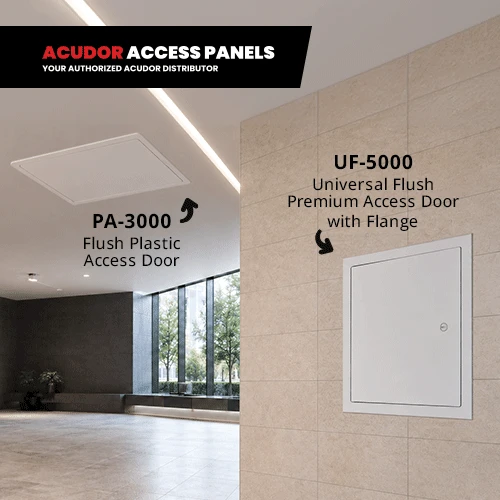
This is where models like ED-2002 and UF-5000 are commonly reused. They're easy to standardize across large portions of a project and support flush wall and ceiling designs where aesthetics matter.
Related: Why Modular Access Panels Help Speed Up Renovations & Multi-Phase Builds
What Conditions Justify Specifying Custom Access Panels?
Custom access panels are justified when standardized products cannot meet physical, performance, or design constraints without compromise.
There are situations where forcing a universal panel into place introduces more risk than it removes. This includes when:
- Openings fall outside standard size ranges—for instance, an extra-large or odd rectangular access pane.
- Wall or ceiling assemblies introduce unique depth or material constraints.
- Universal options cannot meet performance requirements.
- Architectural detailing limits standard frames or reveals irregular openings.
In these situations, customization protects the integrity of the surrounding construction. When inspections, compliance, or durability are at stake, customization becomes a risk-management decision.
That said, custom access panels come with trade-offs. They typically involve longer lead times, higher costs, and more coordination between design, procurement, and installation teams.
As such, they should be specified only when necessary. Failure to do so can introduce complexity without delivering proportional value.
Dealing with an odd-sized opening where pre-made panels are not the right size? Don't force a fit that ends up adding patching work later. Request a quote and estimated lead time based on your access requirements or call +1-888-617-4472.
Related: How Top Architects and Designers Customize Access Panels To Blend Aesthetics With Code Compliance
How Can Early Access Panel Decisions Reduce Cost and Rework?
Early access panel decisions reduce cost and rework by preventing late-stage substitutions, field modifications, and coordination failures. According to the Whole Building Design Guide, early integrated planning and coordination across building systems improve constructability and long-term performance.
When contractors select access panels early, they can coordinate openings with wall and ceiling assemblies rather than adjust after framing. The result is:
- Architects use BIM models to reflect real products rather than placeholders.
- Estimators price accurately instead of building in contingencies.
- Installers arrive on site knowing exactly what they're working with.
- Procurement teams source products early, avoiding last-minute delays, even for custom options.
Late decisions tend to trigger a cascade of small but costly issues in the construction specification strategy, from panels that don't fit to extra patching and finishing work. Individually, these issues may seem minor. But collectively, they add real time and cost.
Related: How Securing All Project-Stage Products in One Order Prevents Costly Delays
How Do ED-2002, UF-5000, and BP-2002 Support Different Project Needs?
ED-2002, UF-5000, and BP-2002 allow teams to balance consistency and flexibility across a commercial build.
ED-2002 Universal Flush Economy Access Door with Flange
The ED-2002 access panel is ideal where access requirements are predictable, and standardization delivers the greatest cost and coordination benefits.
- Its universal design makes it suitable for installation in drywall, plaster, masonry, tile, or any flush surface.
- The budget-friendly price and attractive appearance support large-scale standardization without sacrificing quality.
- The 18-gauge steel door and frame provide durability for high-traffic commercial environments
- Flush door-to-frame design with reinforced edges and a concealed hinge pin helps maintain clean finish lines while standing up to repeated access.
- Stainless steel slot screwdriver–operated cam latch offers secure, low-profile access.
- 1" wide outside flange with a 1 7/16" deep mounting frame simplifies coordination with common assemblies
- 5-stage iron phosphate prep with white alkyd baked-on enamel ensures a consistent, durable finish
UF-5000 Universal Flush Access Door
The UF-5000 access panel is built for projects that need the efficiency of a universal access panel while maintaining clean, flush lines across walls and ceilings.
- Designed for installation in drywall, plaster, masonry, tile, or any flush surface, supporting consistent use across mixed interior conditions.
- Rounded safety corners deliver a softer, architecturally pleasing appearance in high-visibility areas.
- One-piece trim flange welded to the mounting frame prevents sagging or warping over time.
- Flush door-to-frame design and a continuous concealed hinge maintain uninterrupted wall and ceiling planes.
- Heavier-gauge construction scales with size, improving rigidity on larger openings.
- Available in white baked-on enamel or Type 304 stainless steel for design and durability flexibility.
BP-2002 Universal Flush Access Door with Hidden Flange
BP-2002 is well-suited for projects that need a clean, finished appearance in walls and ceilings.
- A unique bevelled door panel overlaps the frame, concealing the hinge and frame for a cleaner visual finish.
- An economical and attractive access door, ideal for apartments, condominiums, and office buildings where access points must blend into finished spaces.
- 16-gauge steel door and frame provide durability while remaining cost-conscious for large-volume use.
- Bevelled-edge door design helps mask minor alignment variances and supports consistent detailing.
- 1/2″ wide outside flange with a 1 1/2″ deep mounting frame supports common wall and ceiling assemblies
- Stainless steel screwdriver-operated cam latch keeps access secure without visual clutter.
- Optional lock and latch configurations allow added control where required.
FAQs About Custom vs. Universal Access Panels
1. What is the difference between universal and custom access panels in commercial construction?
Universal access panels are standardized products designed for repeatable conditions, while custom access panels are built to address non-standard openings, assemblies, or performance requirements.
2. When should I choose a universal access panel instead of a custom one?
You should choose a universal access panel when your project prioritizes speed, consistency, and installation repeatability. Universal access panels work best in projects with common wall or ceiling assemblies, repeated floor plans, and clearly defined access requirements.
3. When are custom access panels actually required on commercial projects?
Custom access panels are required only when physical dimensions, wall or ceiling assemblies, or performance requirements fall outside what standard products can support. This includes irregular openings, unique architectural conditions, or assemblies that demand specific materials or configurations.
4. How can early commercial access panel selection reduce cost and rework?
Early access panel selection reduces cost and rework by preventing late substitutions, avoiding field modifications, and improving coordination between trades. When access panels are chosen during planning, openings can be coordinated with wall and ceiling assemblies, BIM models, and procurement timelines.
Conclusion
The most efficient commercial projects standardize access panels wherever conditions allow and customize when real constraints require it.
Universal access panels support speed, consistency, and long-term maintainability. Custom access panels protect performance and design intent when standard solutions fall short. The balance between the two is where teams minimize risk without sacrificing flexibility.
ED-2002, UF-5000, and BP-2002 access panel support repeatable, low-friction access strategies across predictable conditions.
Used intentionally, they help teams make better decisions early and avoid costly corrections later.
Still debating where to provide custom vs universal access? Avoid RFIs and coordinate final access panel locations with architects to keep your build clean and inspection-ready. Message us with any inquiries or call +1-888-617-4472.
Acudor Access Panels is a trusted and authorized distributor of Acudor products. We proudly bring you their full range of industry-leading access doors and panels.


