

How Do Standardized Access Panels Support Large Commercial Developments? Posted by Acudor Access Panels on 17th Jun 2026
Standardized access panels support large commercial developments by reducing spec variation across multiple buildings. This makes procurement more predictable, speeds up installation, and supports smoother inspections and lifecycle maintenance planning.
By selecting a baseline set of access panels early in the design phase, developers can avoid fragmented purchasing across phases. This reduces the risk of mismatched hardware, inconsistent installs, and last-minute field fixes.
In large-scale commercial construction sites, multiple teams, rotating subcontractors, and multi-year bid cycles are the norm. When access panel requirements vary from one floor or building to the next, multi-phase construction coordination breaks down.
Standardization solves this by creating a repeatable list of default access solutions. It leads to RFI repeatability and ensures aesthetic uniformity across project phases.
Why Does Specification Consistency Matter in Large Commercial Developments?
Specification consistency reduces project risk by eliminating variations in rough openings, installation methods, and hardware requirements across different project phases.
Large developments are vulnerable to specification drift. Products installed in Phase 1 may not match Phase 3 due to value engineering or subcontractor turnover.
Consistent specification minimizes the chaos when dealing with:
- Multiple Buildings or Wings: Ensuring that building A uses the same access logic as building B.
- Rotating Subcontractors: Preventing new crews from improvising their own installation methods.
- Multiple Procurement Cycles: Guarding against budget-friendly substitutions that don't actually fit the architectural details.
Access panels are often viewed as small line items. However, because they appear hundreds of times in a single mega-development, they have a high coordination surface area. When every trade is on the same page regarding the model and size, you avoid the headache of:
- Different keys,
- Conflicting hinge swings, and
- Mismatched finishes that plague maintenance teams for decades.
Stop the RFI spiral and ensure a uniform aesthetic across every floor. Our standardized commercial-grade access solutions help you achieve multi-trade compatibility and eliminate line items that cause project delays. Explore our full range of universal flush access panels to find the right fit for your project.
How Do Standardized Access Panels Reduce Coordination and RFI Risk?
Standardization reduces RFIs by establishing a clear default spec, so teams don't have to make new access-door decisions during shop drawings and submittals. When architects and MEP contractors align on a standard model, it's clear what access door belongs in each wall assembly.
Common coordination failures often stem from:
- Detail Conflicts: The architectural drawings call for a flush-mount panel, but the MEP submittal shows a surface-mount unit.
- Rating Confusion: Uncertainty about where fire-rated doors are required versus where a standard panel suffices.
- Substrate Mismatches: Installing a masonry-specific panel into a drywall partition because the standard wasn't clearly defined.
Using standardized language creates a reliable specification. If a subcontractor substitutes, the difference is immediately obvious. It makes it easier for the project manager to catch and control before the product arrives on-site.
Related: How U.S. Contractors Are Selecting Access Panels for 2026's Largest Commercial Builds
What Installation Efficiencies Come from Repeatable Access Panel Detailing?
Repeatable detailing turns access panels into a predictable scope of work. It allows framing and drywall crews to standardize rough opening sizes and mounting methods across units. This predictability eliminates the need for field fixes, which is where most schedule delays and rework costs come from.
The benefits compound across large developments:
- Faster Rough-In Coordination: Framing crews know exactly what size to leave for standardized access panels without checking every individual room tag.
- Cleaner Trade Handoffs: The MEP trade knows the clearance requirements, and the drywall contractor knows the flange style. The result is fewer late-stage surprises.
- Reduced Rework: Standardization reduces misaligned openings or patches. The installation process is repeatable, which is important, especially in an industry with a growing labor shortage. It reduces the time and skills needed to install access panels from floor to floor.
- Inspection Readiness: Standardized access panels keep installs consistent. They make it easier for site supervisors and building inspectors to verify that the correct panel is in the proper assembly.
- Simplified Inventory: Facilities need only stock a few replacement latches or doors, rather than a warehouse full of varying SKUs.
- Reduced Damage: Because access doors operate consistently, there are fewer improvised fixes that damage the surrounding drywall.
- Portfolio Construction Management: Owners can apply the same access strategy across multiple properties, creating a unified maintenance standard that lowers long-term operational costs.
Approximately $30 to $40 billion in labor productivity is lost annually in construction projects. On large-scale projects, saving five minutes per panel through repeatable detailing can translate into hundreds of labor hours saved over the life of the build.
Lock in your specs and secure a reliable bulk supply for your next multi-phase build. We provide single-source procurement for the ED-2002 and DW-5040, ensuring that the panels installed in your final phase match the quality of the first. Request a quote or call us at +1-888-617-4472.
When Should Access Panel Standardization Be Implemented in Multi-Phase Builds?
Standardization should be implemented as early as the Pre-Design or Schematic Phase. Early planning ensures that default panel specs are baked into the original architectural and MEP drawings.
- Design Development: This is the time to align architectural and MEP sheets. Confirm that the default panel sizes and models are mirrored across all disciplines.
- Preconstruction: Establish clear approved alternates so that any substitutions meet the same standardized performance and aesthetic criteria.
- Procurement Efficiency: A standardized approach allows for bulk purchasing and better lead-time planning, ensuring panels are on-site exactly when the drywallers need them.
Related: How Quick-Install Access Panels Cut Labor Costs &Prevent Costly Project Delays
How Do ED-2002 and DW-5040 Support Commercial Project Standardization?
ED-2002 and DW-5040 access panels support large-scale project standardization by providing a model baseline that covers the vast majority of non-rated interior access needs.
ED-2002 Universal Flush Economy Access Door with Flange
The ED-2002 access panel is a solid standardization option because it can be installed in drywall, plaster, masonry, tile, and other flush surfaces. On large developments where wall types change from area to area, it helps maintain a consistent look throughout.
Here are more reasons this access solution supports standardization:
- Durable Specifications: It's built with 18-gauge steel and a 5-stage iron phosphate preparation. These ensure that the panels installed today won't degrade or mismatch the units installed in a later building phase.
- Economical Option: It's an economical and attractive access door that still delivers durability. For mega projects, the price point and quality make it the ideal repeatable option.
- Concealed Detailing: The concealed hinge pin and formed door panel provide a clean, professional look that meets architectural finish expectations.
DW-5040 Drywall Flush Access Door
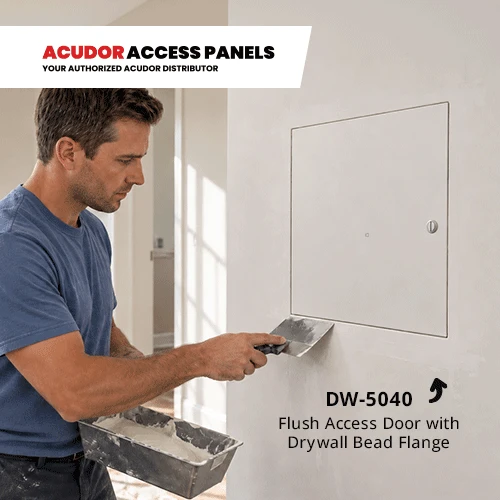
The DW-5040 access panel is designed for installation in drywall walls and ceilings. This access panel model is ideal for achieving a hidden look in residential units or high-end commercial suites.
Standardization strengths include:
- Perforated Taping Bead: This allows the panel to be mudded directly into the wall, achieving a seamless, professional finish.
- Invisible Integration: The unique concealed hinge ensures no hardware protrudes from the panel, satisfying architects who demand a minimalist aesthetic.
- Lightweight Durability: DW-5040 features a 20-gauge galvanized door panel and a 26-gauge galvanized frame. These provide strength without adding unnecessary weight to the ceiling assembly.
- Trade Sequencing Efficiency: Because it is installed after the drywall is up, it simplifies the handoff between the framing and finishing trades, reducing trade sequencing bottlenecks.
FAQs About Standardized Access Panels
1. Can one access panel model be used for both walls and ceilings?
In many non-rated applications, yes. This is a major advantage of standardization. It allows teams to use a single, consistent model across multiple conditions and to reduce the number of SKUs that procurement has to manage.
2. How do I avoid mismatched finish expectations between design and construction?
Start by deciding whether the project priority is a flush, low-visibility finish or a faster, more forgiving installation. Standardization works best when the team agrees on a baseline model early, so the finish expectation is clear before submittals and installation begin.
3. Can I order standardized access panels in bulk with predictable lead times?
Yes, and this is one of the biggest benefits for large developments. Standardizing a small set of models makes it easier to purchase in volume, plan lead times across phases, and avoid last-minute substitutions that create installation and inspection issues.
4. Can standardized access panels be used across multiple buildings with different tenant layouts?
While tenant layouts change, the MEP infrastructure (valves, dampers, junction boxes) often follows a consistent logic that the same standardized panels can serve.
Conclusion
Standardizing access panels is a simple but powerful way to control the complexity of large commercial developments. It helps teams move away from a fragmented, per-room approach to specification.
Instead, developers can apply a portfolio-level strategy using reliable models like the ED-2002 and DW-5040. This shift can reduce RFI volume and support more consistent finish quality across buildings and phases.
It also improves installation speed and makes life easier for the facility manager after turnover. Commercial access door consistency is one of the most reliable ways to reduce risk in large-scale projects.
Ready to eliminate the coordination challenge that stalls project closeouts? On large-scale developments, the smaller details often cause the biggest delays. Our team helps you move toward a standardized SKU strategy that ensures rough opening consistency across every building phase. Contact us so we can help you get your access panel installs right the first time.
Acudor Access Panels is a trusted and authorized distributor of Acudor products. We proudly bring you their full range of industry-leading access doors and panels.


