

How Contractors Meet UL and ULC Fire-Rated Access Door Requirements without Rework Posted by Acudor Access Panels on 1st Jul 2026
Meeting UL and ULC fire-rated access door requirements comes down to three things: specifying the right product for the right jurisdiction, verifying the listed assembly before installation begins, and protecting the listing throughout the installation.
Get any one of those wrong, and you risk a failed inspection, a stop-work order, or costly tear-out and replacement.
In this article, we'll cover the difference between UL and ULC listings, the most common causes of failed fire inspections, and how to verify compliance before work begins. We’ll also look at how the FW-5050-DW meets fire-rated access door conditions and the installation requirements that protect the listing from start to finish.
What's the Difference Between UL and ULC Fire-Rated Access Doors?
The difference between UL and ULC fire-rated access doors comes down to jurisdiction. UL (Underwriters Laboratories) is the recognized testing and certification body in the United States, while ULC (Underwriters Laboratories of Canada) covers Canada.
In the U.S., the International Building Code (IBC) requires fire door assemblies to be listed to NFPA 252, UL 10B, or UL 10C standards. In Canada, the National Building Code of Canada (NBC) requires fire doors to be certified to CAN/ULC S104.
To verify which listing applies to your project:
- Check the project specifications: The Division 08 or applicable spec section will typically state the required listing standard and fire-rating hours.
- Review the construction drawings: Fire-rated wall and ceiling assemblies are identified on the drawings, and the access door must match the assembly's required rating and listing.
- Confirm with the authority having jurisdiction (AHJ): If the listing requirement is unclear from the documents, the AHJ is the final word on what's acceptable in that jurisdiction.
- Cross-reference the UL Product iQ database: This will help you confirm a product's listing before submitting for approval.
Not sure which drywall fire-rated access panel is right for your assembly? Browse Acudor fire-rated access doors for drywall wall and ceiling applications to find UL and ULC-listed options built for commercial and institutional projects.
What Causes Failed Fire Inspections on Access Door Installations?
Failed inspections on fire-rated access panel installations are most commonly caused by mismatched fire ratings, incorrect application, sizing errors, missing or damaged labels, unauthorized field modifications, and failure to maintain the listed assembly.
Mismatched Fire Ratings
Installing an access door with a fire rating that doesn't match or exceed the required hour or minute rating of the wall or ceiling assembly is one of the most direct paths to a failed inspection.
Always confirm against the product's listing before specifying. When in doubt, verify the requirement with the AHJ.
Incorrect Application
A fire-rated access door listed for wall applications is not automatically listed for ceiling applications, and vice versa. Installing a wall-rated door in a ceiling application voids the listing and will result in a failed inspection.
Sizing Errors
Every UL and ULC-listed fire-rated access door carries a maximum size for each application. Exceeding those dimensions means the installation falls outside the tested and listed assembly.
Always confirm the door size against the listing's stated maximum before procurement.
Missing or Damaged Labels
A fire door without a legible label cannot be verified as a rated assembly and will fail inspection. Labels are frequently damaged during shipping, painted over during finishing work, or removed in the field.
Unauthorized Field Modifications
Under NFPA 80, any field modification that voids the door assembly's label will result in a failed inspection. Common violations include cutting the door for non-listed hardware, adding unauthorized fasteners, or drilling openings outside the listing's permitted tolerances.
Failure to Maintain the Listed Assembly
Any component substitution, unlisted hardware addition, or finishing method that disrupts the tested configuration can create a compliance failure, even if the door itself is correct.
How Do You Verify Compliance Before Installation Begins?
You can verify compliance before installation begins by reviewing the product submittal, confirming the listed assembly requirements, and coordinating with the AHJ before any work starts.
Review Submittals
The product submittal is your primary reference for confirming that the specified access door matches the project requirements. Review the submittal sheet for the following before approving:
- The correct UL or ULC listing for the project's jurisdiction.
- The fire rating in hours for both wall and ceiling applications.
- The maximum door size listedfor the intended application.
- The frame type matches the wall or ceiling assembly.
- Hardware specifications, including latch type and hinge configuration.
Confirm Listed Assembly Requirements
Cross-reference the product's listing with the wall or ceiling assembly design to confirm that the framing gauge, drywall thickness, fastener type, and finishing method are all consistent with the listing's requirements.
Coordinate with the AHJ Before Work Begins
The AHJ is the final word on code compliance for any given project. Before installation begins, confirm that the specified product and its listing are acceptable to the AHJ.
This is especially important when a project spans multiple jurisdictions, involves occupancy types with additional requirements, or when the spec is ambiguous about the required listing standard.
How Does the FW-5050-DW Meet UL and ULC Fire-Rated Access Door Requirements for Drywall?
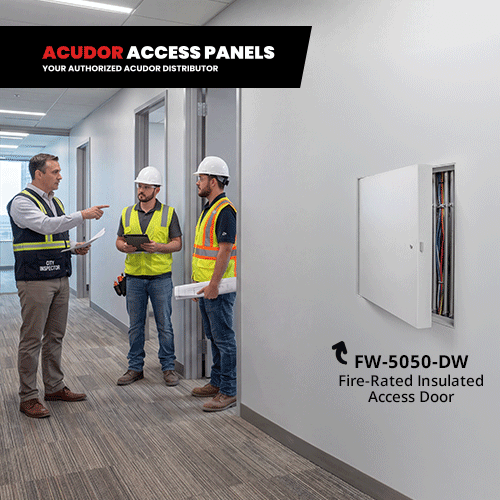
The FW-5050-DW Fire Rated Insulated Door for Drywall meets UL and ULC fire-rated access door requirements through its dual wall listings (UL and ULC), as well as Warnock Hersey International approval for fire-rated ceiling applications.
Let’s look at its key features.
Wall Application Ratings
For wall applications, the FW-5050-DW carries a UL 1½-hour "B" label and a ULC 2-hour "B" label, with a maximum temperature of 250°F after 30 minutes.
The maximum listed door size for wall installations is 36" x 48". Any installation within these parameters is consistent with the product's listed configuration for drywall walls.
Ceiling Application Ratings
For ceiling applications, the FW-5050-DW has been approved by Warnock Hersey International for 3 hours in a non-combustible ceiling and 1 hour in a combustible ceiling, with a maximum door size of 24" x 36".
Important note: Fire-rated access doors do not stop fires from starting; they help slow down the spread of a fire for a limited period.
Drywall Taping Bead Flange for Compliant Finishing
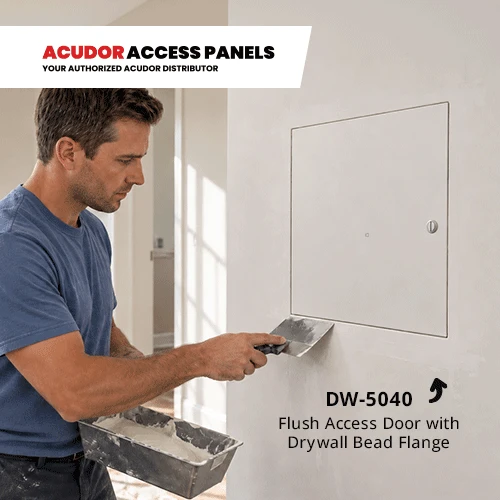
The FW-5050-DW's 16-gauge mounting frame features a galvanized steel drywall taping bead flange. This allows the surrounding drywall to be finished in a way that integrates with the fire-rated assembly without disrupting the listed configuration.
Hardware Features That Support Listing Compliance
Beyond its fire ratings, the FW-5050-DW includes several hardware features that make it suitable for rated wall and ceiling assemblies:
- Door panel: 20-gauge steel, filled with 2-inch thick fire-rated insulation to limit heat transmission through the assembly.
- Self-closing and self-latching:The door closes and latches automatically, which is a key NFPA 80 requirement for fire-rated opening protectives.
- Finish: Steel units receive a five-stage iron phosphate preparation with a prime coat of white baked-on enamel. Stainless steel units carry a #4 satin polish.
Working on a project with fire-rated drywall access door listing requirements? Request a quote for the FW-5050-DW or inquire about our custom sizes if your project requires panels with specific dimensions.
What Installation Requirements Protect the UL/ULC Listing?
The installation requirements that protect the UL/ULC listing are correct anchoring, label retention, and strict limits on field modifications.
Correct Anchoring
The mounting frame must be anchored to the framing in accordance with the product's listed assembly requirements. For drywall wall and ceiling applications, this means using the correct fastener type, quantity, and spacing as specified.
Label Retention
The fire-rating label must remain legible and intact through installation and finishing. Don’t paint over, cover, or remove the label at any point. During drywall finishing, take care to protect the label from mud, tape, and paint.
Field Modification Limitations
The listed assembly must be installed as tested. The following modifications are prohibited unless explicitly permitted by the manufacturer's listing:
- Cutting or trimming the door panel outside the manufacturer's published tolerances.
- Drilling holes or adding hardware not included in the original listing.
- Substituting unlisted hinges, latches, or other hardware components.
- Adding aftermarket devices that alter the door's operation or prevent it from self-closing and self-latching.
Frequently Asked Questions on UL and ULC Fire-Rated Access Doors
1. Does the size of a fire-rated access door affect its fire rating?
Yes. Size can affect a fire-rated access door's ability to achieve and maintain a specific fire rating. Larger doors are generally more challenging to test and certify, which is why UL and ULC listings have a maximum allowable size for each rated application. Exceeding that size takes the installation outside the tested configuration and voids the rating.
2. What happens if the fire-rating label on an access door gets painted over during drywall finishing?
A painted-over label is treated the same way as a missing label during inspection since the door cannot be verified as a rated assembly.
3. Does a fire-rated access door need to be self-closing and self-latching?
Yes. NFPA 80 requires that fire-rated opening protectives be self-closing and self-latching to maintain the integrity of the fire-rated assembly.
To Sum It Up
Meeting UL and ULC fire-rated access door requirements without rework requires you to specify the right listing for the right jurisdiction and confirm the listed assembly before installation begins. You’ll also need to coordinate with the AHJ early and protect the listing through careful installation and label retention.
Need help selecting code-compliant access doors for your next project? Contact us or call +1-888-617-4472. Our team will help you match the right product to your project specifications, listing requirements, and inspection standards.
Acudor Access Panels is a trusted and authorized distributor of Acudor products. We proudly bring you their full range of industry-leading access doors and panels.


