

Why Workforce Shortages Are Forcing Contractors to Innovate & What Works Posted by Acudor Access Panels on 15th Apr 2026
Workforce shortages are forcing contractors to change how they deliver projects because they can’t rely on having enough experienced labor on every job.
Across the U.S., surveys estimate that the construction industry needed to attract roughly half a million additional workers in 2024 and 2025 just to meet demand, and that gap is already driving project delays and higher costs.
As a result, contractors have to lean on solutions that are more repeatable across projects and less dependent on highly specialized crews to keep schedules intact and protect margins.
In this article, we’ll look at how construction workforce shortages are impacting timelines, when to adjust specifications, and how standardized access panels, such as ED-2002 and UF-5000, support productivity in labor-constrained commercial projects.
How Are Workforce Shortages Impacting Commercial Construction Timelines?
Workforce shortages are impacting commercial construction timelines by creating chronic staffing gaps, overloading crews, and increasing rework and coordination issues across multiple projects.
A recent survey conducted by NCCER and the Associated General Contractors of America (AGC) reports that 92% of contractors are struggling to fill open positions. The same survey shows that workforce shortages are now the leading cause of project delays, with nearly half of firms reporting delays due to a lack of their own or subcontractors’ workers.
On-site, this results in:
- Longer critical-path durations because you can’t staff all concurrent activities at full strength.
- Bidding decisions driven by labor, as you weigh whether your current team can realistically handle another schedule.
- Increased RFI volume when less-experienced teams struggle with complex details, especially when product data is inconsistent across projects.
- Higher risk of rework when rushed or new crews misinterpret installation instructions.
When Should Contractors Adjust Specifications to Address Workforce Limitations?
Contractors should adjust specifications as soon as they notice that labor shortage is likely to affect schedule reliability, repeat work scopes, or their ability to staff multiple projects with experienced installers.
Common triggers to watch out for include:
- Multiple projects competing for the same workforce.
- High percentage of new or temporary workers.
- Complex, one-off details that generate RFIs.
- Aggressive schedules with limited float.
At that point, it’s worth revisiting your specs and asking:
- Can we standardize sizes, hardware, and installation methods across projects?
- Are we using unnecessarily complicated products when a simpler, universal option would achieve the same performance?
- Where can we shift to labor-efficient construction materials that reduce field cutting, custom framing, or the need for specialty tools?
What Material and Specification Changes Help Reduce Labor Strain?
The most effective material and specification change you can make to reduce labor strain is to simplify installation steps, minimize field modifications, and keep details consistent across projects.
This means prioritizing:
- Universal, multi-surface compatibility: For example, panels that work in drywall, plaster, masonry, tile, and ceilings or walls, like universal flush access panels, let you carry one detail and installation sequence from project to project.
- Standardized dimensions and cutouts: Repeating the same rough openings and framing layouts across jobs improves workflow efficiency and reduces layout errors.
- Factory-primed or prefinished components: Elements that arrive ready for paint or finish reduce multi-project coordination between trades and hastens close-out.
- Straightforward hardware and tools: Latches and hardware that operate with a standard screwdriver instead of specialty keys reduce confusion and callbacks
- Clear installation instructions: Products with simple installation guidelines reduce training time for new crews and reduce RFIs.
Explore our flush access doors to learn how standardized access panels can support productivity in labor-constrained commercial projects.
How Do Standardized Access Panels Improve Installation Efficiency?
Standardized access panels improve installation efficiency by turning a fragmented, high-variation detail into a repeatable task that crews can execute quickly and consistently.
When you standardize access panels across your projects, you’ll be able to:
- Reduce layout and framing time: Crews know the rough opening dimensions, flange width, and frame depth in advance, so they can prep openings while other work progresses.
- Shrink the learning curve: Once installers understand one universal flush panel, they can apply the same steps in drywall, plaster, masonry, or tile.
- Cut RFIs and field questions: Standardized access panels with consistent hardware and hinge locations reduce ambiguity about clearances, swing direction, and mounting.
- Lower rework risk: Fewer product variations mean fewer opportunities to order the wrong size, cut the wrong opening, or misalign the frame.
- Support schedule protection: When crews can install panels quickly and confidently, inspections and follow-on trades (paint, finishes, commissioning) will stay on track.
Related: How Quick-Install Access Panels Cut Labor Costs & Prevent Costly Project Delays
How Do ED-2002 and UF-5000 Support Productivity on Labor-Constrained Projects?
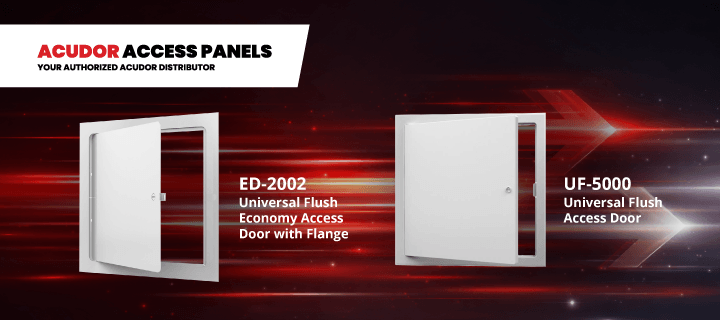
The ED-2002 Universal Flush Economy Access Door and UF-5000 Universal Flush Access Door support productivity by offering universal, flush access solutions that install the same way across multiple substrates. This minimizes field adjustments and provides options for both economy and higher-end applications.
Let’s look at each panel in detail.
ED-2002 Universal Flush Economy Access Door
The ED-2002 access panel is an economical option for walls and ceilings where you need straightforward access to MEP systems and fast, predictable installation.
Key features that optimize labor and repeatable work include:
- Universal application: You can install ED-2002 in drywall, plaster, masonry, tile, or any flush surface. This makes it a practical choice when you want to standardize details across different building types, areas, and project phases.
- Durable construction: The door and frame are made from 18-gauge steel, providing a solid, long-lasting assembly that withstands heavy use in busy service areas and high-traffic corridors.
- Flush, reinforced door: A formed door panel sits flush to the frame with reinforced edges to maintain a smooth finish plane and reduce snag points for people and equipment.
- Installer-friendly frame: A 1" wide outside flange and a 1 7/16" deep mounting frame provide crews with a clear, repeatable reference for layout and fastening. On common sizes (6" x 6", 8" x 8", 10" x 10", 12" x 12"), knock-over mounting tabs further speed up installation by reducing the need for additional anchors.
- Simple concealed hardware: A concealed hinge pin protects the panel’s appearance and reduces the risk of damage, while the stainless steel, screwdriver-operated cam latch allows installers and maintenance teams to open the door with a standard screwdriver.
- Ready-for-paint finish: A 5-stage iron phosphate preparation with a prime coat of white alkyd baking enamel means the panel arrives ready for paint. This simplifies coordination with finish crews and helps you move faster toward close-out.
UF-5000 Universal Flush Access Door
The UF-5000 access panel adds more architectural and safety-focused features while preserving the same universal, labor-saving installation approach.
Its key features include:
- Universal, multi-surface use: Like ED-2002, UF-5000 is designed for installation in drywall, plaster, masonry, tile, or any flush surface, so you can carry one detail from utility spaces to more visible public areas.
- Architectural safety corners: The door panel has rounded safety corners that provide an architecturally pleasing appearance and reduce the risk of sharp-edge injuries in tight corridors or mechanical rooms.
- One-piece trim flange: The one-piece outer flange welded to the mounting frame is engineered to prevent racking, sagging, or distortion to maintain a clean reveal and reduce touch-up work over time.
- Continuous concealed hinge: The continuous concealed hinge is built to remain friction-free. This supports smooth operation even after repeated use and minimizes callbacks for adjustment.
- Heavy-gauge options: UF-5000 uses a 16-gauge door with an 18-gauge mounting frame for sizes up to 16" x 16". Larger sizes use a 14-gauge door with a 16-gauge frame for added rigidity in bigger openings.
- Flexible security options: A standard stainless-steel screwdriver-operated cam latch keeps operation simple, while optional cylinder locks and alternate cam latches (allen head, spanner head) offer upgrade paths when additional security is needed.
- Finish options: Steel units use the same 5-stage iron phosphate preparation with a prime coat of white alkyd baking enamel, while Type 304 stainless steel with #4 satin polish is available where corrosion resistance or a higher-end finish is required.
Ready to reduce labor pressure on your next project? Request a quote for ED-2002 or UF-5000 so our team can help you streamline installation and standardize your access panel packages.
Frequently Asked Questions on Standardized Access Panels
1. How do standardized access panels help reduce rework on commercial projects?
Standardized access panels reduce construction rework by eliminating guesswork around sizing, framing, and hardware. This helps prevent miscut openings, misaligned frames, and wrong hardware selections, which are common drivers of rework in ceilings and walls.
2. Can one access panel type really work across different wall and ceiling materials?
Yes. If the surrounding assembly is framed to support the opening and you follow the manufacturer’s fastening recommendations, you can rely on one standardized access panel family across varied substrates to simplify material planning and installation repeatability.
3. How do I choose between an economy access panel and a more robust universal model?
Use an economy model like ED-2002 when you need reliable, everyday access in back-of-house or service spaces and the budget is tight. Choose a more robust, architecturally refined model like UF-5000, when the panel will be installed in a high-visibility area and aesthetics matter.
To Sum It Up
Construction workforce shortages are reshaping how contractors deliver projects. You now have to treat material and specification decisions as core tools for maintaining commercial construction productivity.
By choosing standardized access panels and repeatable details, you can give your team a clear path to consistent quality, even when experienced labor is hard to find.
If you’re looking to coordinate standardized access panels for your next project, contact our team or call +1-888-617-4472 to specify universal access panels that can help safeguard your schedule.
Acudor Access Panels is a trusted and authorized distributor of Acudor products. We proudly bring you their full range of industry-leading access doors and panels.


