

What Acoustic Requirements Matter When Specifying Access Panels in Commercial Buildings? Posted by Acudor Access Panels on 20th May 2026
The acoustic requirements that matter when specifying access panels are the STC rating of the surrounding wall or ceiling assembly, the panel’s tested sound-control performance, perimeter sealing, and installation quality.
If the assembly is designed to reduce sound transfer, the access panel must help maintain that performance. In commercial buildings, this is crucial because privacy, occupant comfort, and long-term building performance all depend on proper sound control.
In this article, we’ll look at what STC ratings commercial buildings require and which project types trigger acoustic access panel requirements. We’ll also cover what to look for during product selection and how the ACD-2064 access panel supports commercial building sound control.
What STC Ratings Do Commercial Building Codes Actually Require?
According to the International Building Code, a Sound Transmission Class (STC) of 50 is the common code benchmark for many sound-rated wall and floor-ceiling assemblies in U.S. buildings. This is especially common where dwelling units or sleeping units are separated from each other or from public/service areas.
However, this doesn’t mean every commercial wall needs an STC of 50.
Field-tested assemblies may use a lower benchmark, such as NNIC 45 under ASTM E336 . Buildings often have flanking paths, installation variables, and site conditions that affect acoustic performance. The required rating depends on:
- The building type
- Occupancy
- Local code
- Project specifications
- Recommendations from an acoustic consultant.
If you’re installing an access panel in a wall or ceiling assembly that requires a specific STC rating, the panel should support the acoustic performance of the surrounding assembly. Otherwise, it can become a weak point in the sound-rated wall or ceiling, which would reduce acoustical performance and increase the risk of inspection issues, rework, or occupant noise complaints.
Related: How Can Code-Compliant Access Panels Help Commercial Projects Pass Inspection Without Delays?
Which Project Types and Spaces Trigger Acoustic Access Panel Requirements?
Acoustic access panels are often required when the wall or ceiling assembly is designed to control sound, protect privacy, reduce disturbance, or meet a project-specific STC requirement. This is common in spaces where noise transfer can affect occupants, operations, or building code compliance.
Some of these areas include:
- Healthcare facilities, including exam rooms, patient rooms, consultation rooms, therapy areas, and diagnostic spaces.
- Office buildings, especially private offices, meeting rooms, boardrooms, HR rooms, and executive areas.
- Schools, universities, training rooms, and lecture spaces.
- Hotels, mixed-use buildings, and multifamily projects with commercial service areas.
- Theaters, studios, performance spaces, and media rooms.
- Mechanical rooms next to occupied spaces.
- Corridors, service areas, and partitions separating noisy zones from quiet zones.
Explore our acoustical access panels built for sound-rated wall and ceiling assemblies. The panels will help your access points meet your project’s STC requirements, so you can avoid inspection issues, rework, or noise complaints.
What Happens When an Access Panel Doesn't Match the Assembly's Acoustic Rating?
When an access panel doesn’t match the assembly’s acoustic rating, it can create a sound leak that reduces the performance of the entire wall or ceiling system.
This can create problems such as:
- Failed field acoustic testing.
- Delayed sign-off or turnover.
- Costly rework around finished walls or ceilings.
- Schedule disruption across trades.
- Occupant noise complaints after handover.
- Reduced confidence from owners, consultants, and repeat clients.
What Should Contractors Look for When Specifying an Acoustic Access Door?
Contractors should look for an acoustical access panel with a tested acoustic rating, compatible wall or ceiling application, reliable perimeter sealing, and a finish that blends with the surrounding assembly. The goal is to preserve the design intent without creating a weak point at the access location.
With that in mind, always confirm these details before you choose an acoustic access door:
- Tested acoustic performance: Choose a panel with documented STC ratings. If the project also involves exterior or transportation noise, confirm whether OITC performance is relevant.
- Perimeter sealing: A good acoustic access door needs a reliable gasket or seal because even small gaps around the frame can reduce sound-control performance.
- Latch and closure performance: Compression latching maintains contact at the perimeter seal, ensuring the door closes securely and consistently.
- Frame strength and installation support: The frame must remain rigid and properly seated in the opening, as movement, gaps, or poor installation can reduce performance.
- Compatibility with drywall walls and ceilings: For acoustic drywall assemblies, the panel should integrate cleanly with the surrounding finish to reduce visual disruption while supporting sound-control intent.
How Does the ACD-2064 Meet Acoustic Requirements in Commercial Buildings?
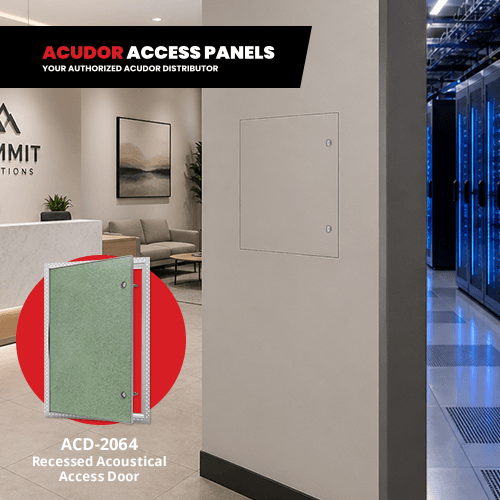
The ACD-2064 Acoustical Access Door for Drywall meets noise control requirements in commercial buildings by combining a certified STC rating of 64 and an OITC rating of 53 with perimeter sealing and a recessed, drywall-ready design.
Let’s look at the key features that help it maintain acoustic performance while still providing reliable service access.
Certified Acoustic Performance for Sound-Rated Assemblies
The ACD-2064 access panel is tested and evaluated to ASTM E90(09), ASTM E413(16), and ASTM E1332(16). It’s certified to:
- STC rating of 64 for airborne sound control through wall and ceiling assemblies.
- OITC rating of 53 for outdoor-indoor noise reduction.
Recessed Drywall Design for a More Integrated Finish
The ACD-2064 is designed for acoustical drywall walls and ceilings. Its recessed door is fitted with a 5/8” thick drywall that helps the finished face blend with the surrounding surface.
The drywall taping bead flange also supports a concealed finish, which is useful in spaces where both acoustic performance and appearance matter. These include offices, healthcare areas, meeting rooms, classrooms, and other noise-sensitive commercial interiors.
Acoustic Core, Barrier, and Insulated Frame
The ACD-2064 is built with multiple sound-control components that support its acoustic rating.
The door includes:
- An 18-gauge recessed satin coat steel design for strength and stability.
- A 1½” thick acoustic insulation (acoustic mineral liner) to help reduce sound transfer.
- A 0.11” thick mineral-filled vinyl barrier for added sound-control performance.
- A 5/8” thick drywall finished face to better match the surrounding assembly.
Perimeter Sealing and Secure Closure
Sound can pass through small gaps, so sealing is a major factor in the performance of acoustic access doors. The ACD-2064 includes a silicone perimeter seal gasket to help control sound leakage around the door frame.
It also comes with a standard screwdriver-operated compression latch. This helps keep the door pulled securely against the gasket after service access.
For projects that require different access-control options, the model can also be specified with compression-latch options such as hex head, hex with security pin, square, or triangle.
Durable Hardware for Ongoing Maintenance Access
The ACD-2064 features a continuous, exposed stainless steel piano hinge that maintains consistent alignment during repeated opening and closing.
The zinc- or satin-coated steel construction also provides corrosion resistance and long-term durability in typical commercial interior applications.
If your project requires access points to be installed in acoustical walls or ceilings, request a quote or submit custom size requirements for the ACD-2064 access panel to get a solution that fits your project’s STC, OITC, and acoustical needs.
Frequently Asked Questions on Sound-Rated Access Doors
1. What is the difference between an acoustical access panel and a standard access panel?
An acoustical access panel is built to reduce sound transmission through the access opening. A standard panel may provide service access, but it’s not designed to maintain the STC rating of a sound-rated wall or ceiling assembly.
2. Can one non-rated access panel affect the wall’s acoustic performance?
Yes. A non-rated access panel can become the weak point in a sound-rated assembly. Sound will often travel through the easiest path, and a thin or poorly sealed access door can reduce the performance of the entire partition.
3. Does an STC-rated access panel guarantee the wall will pass field testing?
No. Although a tested access panel supports the acoustic performance of an assembly, field results also depend on installation quality, sealing, framing, flanking paths, and surrounding construction. According to ASTM, laboratory ratings may not directly match building performance because buildings can have other sound paths.
The best approach is to match the access panel to the rated assembly and coordinate installation details before construction reaches the completion stage.
To Sum It Up
Specifying acoustic access panels in sound-rated walls and ceilings is crucial since a single weak access point can compromise the performance of the entire sound-rated assembly.
This can result in inspection delays, rework, and schedule pressure for contractors, as well as privacy issues, noise complaints, and long-term performance concerns for owners and facility teams.
The right acoustic drywall access door should align with the project’s sound-control intent and blend with the surrounding assembly. The ACD-2064 access panel does exactly that with an STC Rating of 64 and an OITC Rating of 53.
Contact us or call +1-888-617-4472 to place an order or discuss your access panel specifications with our team so your access points can match your project’s acoustic requirements.
Acudor Access Panels is a trusted and authorized distributor of Acudor products. We proudly bring you their full range of industry-leading access doors and panels.


