

What Contractors Need to Know about Airtight Access Panels for Building Envelopes Posted by Acudor Access Panels on 25th Mar 2026
Airtight access panels prevent air leakage and pressure loss without blocking access to MEP systems. These specialized components use high-compression gaskets and reinforced frames to ensure that the air barrier remains continuous. This eliminates the risk of failed blower door tests and costly post-construction rework.
In high-performance construction, a poorly sealed access opening can compromise an entire building envelope.
When air escapes through a standard loose panel, it does more than waste energy. It triggers inspection failures, moisture issues, and expensive corrective sealing.
This article explains what defines a true airtight panel and where they are most critical. It also discusses the GDD access panel and how it supports airtight and containment-sensitive assemblies.
Why Are Access Panels a Weak Point in Airtight Building Envelopes?
Building envelope access requires air barrier continuity to function. Every access point represents a deliberate opening in that barrier. If the door installed isn't an airtight access panel, it becomes a permanent leak point.
In commercial construction, these gaps are often the primary reason a building fails its final ductwork leakage or pressure test.
Several factors typically lead to these failures in the field:
- Use of "Standard" Panels: Contractors often install general-purpose panels where airtight performance is required, assuming a close fit is good enough.
- Uneven Gasket Compression: Lower-quality seals or foam tapes tend to lose their memory or compress unevenly over time, creating micro-gaps.
- Frame Racking: If a frame isn't rigid, it can distort during installation, preventing the door from seating perfectly against the seal.
- Weak Latching: Standard latches often fail to pull the door leaf tight enough against the gasket to create a true pressure seal.
When these failures occur, the consequences for a superintendent are immediate. Air leakage control becomes a nightmare during commissioning, leading to desperate caulk-and-tape fixes that look unprofessional and rarely last.
Don't let duct leakage derail your project timeline. Maintaining air barrier continuity in your mechanical systems requires specialized hardware designed to withstand pressure. Explore our full range of specialty duct access doors built for airtight access.
What Defines an Airtight Access Panel in Commercial Construction?
An airtight access panel is defined by its ability to provide pressure-containment access. Essentially, its seal should withstand pressure and repeated use. Unlike a standard sealed door, a true airtight panel uses a positive-pressure design.
The hardware and gasketing work together to create an airtight mechanical seal that withstands even significant pressure differentials created by the building's HVAC system.
To ensure duct or commercial envelope coordination and performance, look for these "must-have" features:
- Compression Gaskets: Avoid simple foam tape. Professional panels use heavy-duty, bulb-style, or neoprene gaskets that regain their shape.
- Reinforced Frames: The frame must stay perfectly square even if the wall shifts, ensuring the door leaf always hits the seal evenly.
- Positive Latching: A latching system should draw the door into the frame, compressing the gasket rather than just holding the door shut.
- Pressure Rating: Pressure-rated assemblies are tested to ensure consistent leakage prevention under specific Pa (Pascal) ratings. Access panels must uphold these ratings.
A sealed door is merely one that is closed tightly. An airtight door, on the other hand, is a performance-rated assembly that maintains containment integrity through years of maintenance cycles.
Related: How Do Acudor Access Panels Contribute to a Building's LEED Certification?
Where Are Airtight Access Panels Most Critical within Building Systems?
Airtight access panels are most critical where there is a significant pressure difference between two spaces or between the interior and exterior. Identifying these high-risk zones early prevents energy loss from air leakage.
- Ductwork and Mechanical Shafts: These are the primary highways for air. Any access point here is a vulnerability for leakage that can bypass the main building air barrier.
- Air Handling/Mechanical Rooms: These rooms are often under high pressure. Standard doors here will leak constantly, forcing the system to work harder to maintain setpoints.
- Pressure-Controlled Corridors: In hospitals, labs, or clean rooms, maintaining a pressure gradient is a safety requirement; leakage here is a compliance failure.
- Vertical Risers: Service chases create strong vertical air movement due to the stack effect. Without airtight panels, they become a direct path for conditioned air to escape.
- High-Performance Envelope Penetrations: Anywhere a technician needs to reach a valve or sensor within the thermal envelope, an airtight solution is required to keep the air barrier intact.
Related: 3 Duct Types That Drive HVAC Efficiency and Air Quality in Commercial Projects
How Does GDD Support Airtight Access in Containment-Sensitive Applications?
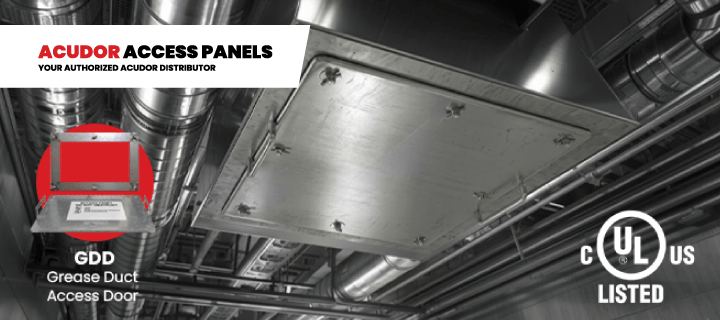
The GDD Grease Duct Access Panel is engineered for the high-stakes environment of kitchen exhaust systems and grease ducts. In the field, GDD supports contractors and inspectors by providing:
- Code-Compliant Performance: Being UL/ULC-listed means it is purpose-built for fire safety and airtightness, streamlining the sign-off process.
- Leakage Prevention: Its high-temperature gasket maintains a consistent seal even under the thermal expansion and pressure fluctuations common in exhaust systems.
- Non-Invasive Installation: The bolt-in design is engineered so that no bolts penetrate the duct interior. This eliminates potential snag points for grease and preserves the integrity of the airflow.
- Simplified Maintenance: Features a removable hinge-less design with two dedicated handles. It allows technicians to pull the door completely away for full service access without struggling with swinging doors in tight chases.
- Precision Fit: Each unit includes a duct cutout template, ensuring that the field-cut opening matches the panel for a seamless, airtight transition.
- Durable Finish: The galvanized steel finish and a specialized one-flange design provide a long-lasting, corrosion-resistant barrier. The barrier protects the building envelope from the hazardous air and grease migration often found in commercial kitchen applications.
Whether you’re trying to control the stack effect in service risers or need a grease-tight seal without drilling into the duct, the GDD is a simple solution. It meets code requirements and does not require any duct penetration. Get a quote today and lock in the right specs before your next mechanical rough-in.
Frequently Asked Questions about Airtight Access Panels
1. Can I use weatherstripping on a standard access panel to make it airtight?
No. Basic weatherstripping doesn't maintain a consistent seal under pressure, repeated opening/closing, or long-term compression. Airtight access panels use compression gaskets and latching systems designed specifically to hold the seal and prevent leakage.
2. Does a grease duct access panel need to be welded?
Not always. Some grease duct access panels can be installed as a bolt-in unit, provided they use the correct high-temperature gasket and fastening method to maintain a sealed, code-compliant opening. For example, a bolt-in option like GDD can provide secure access without requiring welding.
3. Do airtight access panels actually affect building envelope test results?
Yes. In a high-performance building, the cumulative leakage from multiple non-airtight panels can exceed the allowable CFM (cubic feet per minute) leakage rate, resulting in a failed blower door test.
4. Where do contractors most commonly lose air barrier continuity around access openings?
The most common failure is the interface between the panel frame and the wall's air barrier. Even if the panel is airtight, if the transition isn't properly caulked or taped, air will leak around the frame's edges.
Conclusion
Airtight access panels are a small but vital component in modern commercial airtight construction. By choosing a solution that prioritizes leakage prevention, contractors can protect the building envelope's integrity, reduce duct leakage, and still allow easy mechanical system access.
Don't risk failed inspections or expensive corrective work. Specify a panel that is designed for the pressure. GDD, for instance, provides the inspection-ready solutions needed for airtight and containment-sensitive assemblies.
Airtight access panels ensure your project meets its performance goals from day one through the building's entire lifecycle.
Not sure if your access points will pass the final pressure test? It only takes one unsealed opening to compromise your pressure readings. We help contractors standardize submittals with panels that actually meet airtight and grease-tight specs. Contact our team to find the right hardware for your air leakage control needs. Call us at +1-888-617-4472 today.
Acudor Access Panels is a trusted and authorized distributor of Acudor products. We proudly bring you their full range of industry-leading access doors and panels.


