


How Sustainability & Energy Codes Are Changing Access Panel Specifications Posted by Acudor Access Panels on 23rd Mar 2026
Sustainability and energy codes are changing how access panels are being specified because they now treat them as part of the building envelope.
As a result, you have to think about insulation, air leakage, documentation, and how each access point affects overall building envelope performance and energy modeling assumptions.
In this article, we’ll look at how sustainability goals shape access panel specs, when to evaluate panels for energy and code alignment, which features support commercial energy efficiency, and how the FW-5050 access door fits into sustainable commercial construction.
How Are Sustainability Goals Influencing Access Panel Specifications?
Sustainability goals now require you to treat access panels as part of the thermal envelope, with expectations for insulation, airtightness, durability, and traceable performance.
This shift shows up in three ways for access panel specifications:
- Thermal envelope continuity: Commercial energy-efficiency access doors are now expected to support the R-value and U-value targets of surrounding walls and ceilings as much as possible.
- Air leakage control: Research shows that uncontrolled air leakage can account for roughly 30- 50% of a typical building’s heating and cooling costs. This means access panels need solid construction, good fit, and detailing that doesn’t create obvious leakage paths.
- Lifecycle energy performance and documentation: Sustainable access panels are increasingly specified with clear ratings, test data, and installation instructions, so inspectors and energy consultants can confirm that each access point maintains the continuity of the fire and thermal envelope.
Check out our specialty access doors to learn how you can align access panel specifications with evolving sustainability goals and energy code requirements.
Why Do Energy Codes Place More Scrutiny on Building Access Points?
Energy codes place more scrutiny on access points because they’re potential weak spots in the continuous insulation and air barrier that modern codes now require for commercial buildings.
Commercial energy standards and codes, such as ASHRAE 90.1 and the International Energy Conservation Code (IECC), treat the building envelope as a system that must control heat flow and air leakage.
Because of this, access doors that once passed with a basic fire label now attract questions like:
- Does this panel undermine the wall or ceiling U-value?
- How does it affect air leakage test results?
- Is there documentation to support the energymodeling assumptions?
If your access panel specs can’t answer those questions, you risk delays, rework, or additional on-site detailing late in the project.
Related: How Can Code-Compliant Access Panels Help Commercial Projects Pass Inspection Without Delays?
When Should Access Panels Be Evaluated for Energy and Code Alignment?
You should evaluate access panels for energy and code alignment during envelope design and energy modeling, then verify them again during submittals and installation.
Waiting until rough-in or closeout makes it hard to address weak points without incurring cost and schedule impacts.
A practical approach is to build access panel checks into four stages:
- Concept and schematic design
- Identify where risers, shafts, and service zones intersect with exterior walls, roofs, and fire-rated assemblies.
- Flag locations where you know you’ll need access for valves, controls, and inspection points.
- Design development and construction documents
- Coordinate sustainable access panels explicitly in wall and ceiling types, not just in a generic hardware schedule.
- Make sure details show how the panel integrates with insulation, fire separations, and air/vapor barriers, so energy-code reviewers see consistency.
- Submittals and procurement
- Confirm that selected access panels meet fire-rating needs and support building envelope performance as much as possible, through insulation, robust construction, and documented ratings.
- Align submittals with the energy modeling report, especially if your project follows NECB 2020-based modeling guidelines that track heat loss through thermal bridging and envelope components.
- Installation and inspection readiness
- Verify that access doors are installed as per the manufacturer's instructions and that the adjacent insulation and membrane details are continuous.
- Document locations, ratings, and any special sealing or insulation steps for energy and sustainability documentation.
What Access Panel Features Support Energy-Efficient Construction?
Access panel features that support energy-efficient construction are those that minimize thermal and air leakage while delivering safe, code-compliant access.
Key features to look for in energy-efficient access panels include:
- Insulated door panel: A door filled with thick, fire-rated insulation helps reduce heat transfer through the opening.
- Robust, well-fitting construction: Steel or stainless steel door and frame assemblies with precise fit reduce unintended air paths around the door. This helps control air leakage when combined with proper detailing at the frame.
- Self-closing, self-latching operation: If an access door is left slightly open, it effectively becomes a permanent breach in the envelope. Self-closing and self-latching hardware reduces the risk of panels being left open in shafts, corridors, and service rooms.
- Compatibility with fire-rated assemblies: Fire-rated access panels that match the fire separation allow you to maintain energy performance without resorting to ad hoc solutions that compromise insulation or detailing.
- Clear ratings and documentation: Fire labels, maximum size limitations, and construction specs provide building officials and energy consultants with the information they need to confirm compliance without additional RFIs.
How Does FW-5050 Fit into Sustainability-Driven Commercial Projects?
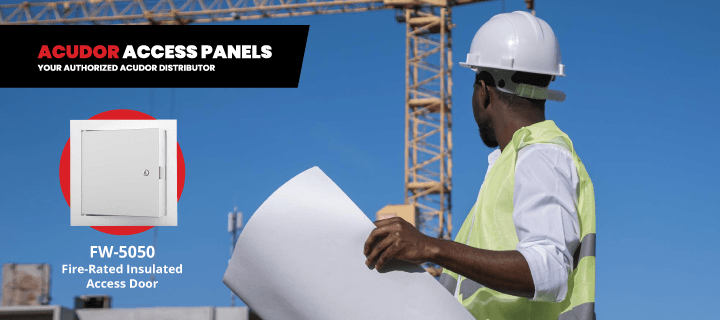
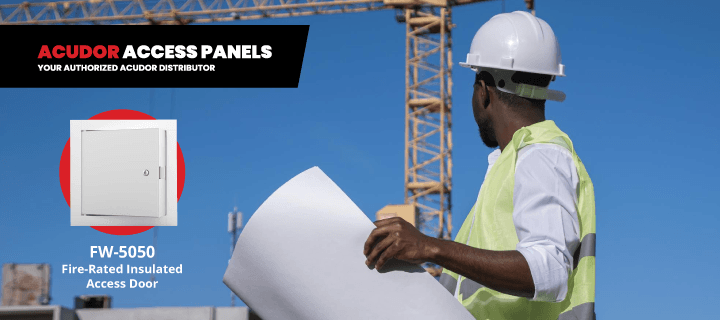
The FW-5050 access door fits sustainability-driven commercial projects by combining robust fire ratings with an insulated, well-constructed door assembly that helps control heat transmission in walls and ceilings where temperature rise is a concern.
Some of its key features that support building envelope performance include:
Insulated Construction For Better Thermal Control
The panel comes with a 20-gauge steel or stainless steel door and a 16-gauge mounting frame. The door is filled with 2" thick fire-rated insulation and a 1" wide flange that seats cleanly in the opening.
Fire Ratings Aligned With Common Code Scenarios
For walls, the FW-5050 carries a UL 1-1/2-hour “B” label and a ULC 2-hour “B” label (up to a maximum size of 36" x 48").
In ceilings, the FW-5050 carries a 3-hour Warnock Hersey International rating for non-combustible ceilings and a 1-hour rating for combustible ceilings (up to 24" x 36").
Applications That Intersect Energy and Safety Goals
FW-5050 is designed for all types of walls and ceilings and is specifically recommended for walls where temperature rise or heat transmission is a factor.
This makes it a strong fit for:
- Fire-rated mechanical and electrical risers.
- Service rooms where hot equipment sits behind rated walls.
- Ceiling applications where you must preserve both fire resistance and reasonable control of heat transfer.
Features that support envelope continuity and inspection readiness
The FW-5050 comes with a concealed hinge design that helps it achieve a cleaner, more seamless appearance in finished spaces.
It also includes a self-closing, self-latching operation with an inside latch release, which improves safety and reduces the chance of the panel being left open.
A universal self-latching bolt operated by a knurled knob or flush key is standard, with the option to prepare for mortise cylinder locks when master keying is required.
The panel is also available in the following finishes:
- Steel with 5-stage iron phosphate prep and a prime coat of white baked-on enamel.
- Stainless steel with a #4 satin polish.
Ready to align your access panel selection with evolving energy and sustainability requirements? Request a quote for the FW-5050 access door to discuss project-specific needs with our team.
FAQs on Energy Code Access Panel Requirements
1. Do access panels have to be insulated to meet energy code requirements?
Energy codes don’t always prescribe a specific R-value for every access door, but they do require the overall envelope to meet U-value and air leakage limits. For panels in exterior walls, roofs, or other thermal envelope locations, insulated access doors make it easier to match the performance of the surrounding assembly and avoid local cold spots.
2. How do access doors affect air leakage testing and airtightness targets?
Air leakage tests for the whole building measure how much air escapes through the entire envelope. As a result, any gaps around access doors that don’t close tightly will show up in the blower-door results, just like poorly sealed windows or joints would.
3. When should I flag access panels to energy consultants and modelers?
You should flag access panels whenever they penetrate the thermal envelope, especially in exterior shafts, service risers, and roof assemblies. During energy modeling, your consultant may not model every individual door, but they will assume a certain level of thermal continuity and airtightness.
Sharing details on insulated, fire-rated panels helps them confirm that real-world construction aligns with the assumptions in their models and with code compliance reports.
To Sum It Up
Sustainability targets and modern energy codes are now transforming access panels into a visible part of your building envelope strategy. Instead of treating them as generic hardware, you now need sustainable access panels that support thermal envelope continuity, air leakage control, and clear documentation for energy modeling and inspection.
By evaluating access panel locations early, coordinating them with wall and ceiling assemblies, and choosing insulated products, you can protect your budget, reduce rework, and deliver projects that perform closer to their design intent over the building lifecycle.
Contact our team or call +1-888-617-4472 to coordinate your access panel strategy if you’re planning a sustainable commercial construction project or updating specifications to reflect new energy code requirements for access panels.
Acudor Access Panels is a trusted and authorized distributor of Acudor products. We proudly bring you their full range of industry-leading access doors and panels.


