


How Do Insulated Access Doors Help Reduce HVAC Load & Save Energy? Posted by Acudor Access Panels on 17th Feb 2026
Insulated access doors help reduce HVAC load and save energy by limiting heat transfer and air leaks at access openings in your building envelope.
When you insulate walls and roofs but leave access doors thin, uninsulated, or leaky, they act like small holes in what would otherwise be a solid assembly.
As a result, conditioned air slips out, unconditioned air sneaks in, and your HVAC system has to run longer to keep indoor spaces comfortable. Over time, that extra runtime shows up as higher utility bills, more wear on equipment, and difficulty meeting energy targets.
Insulated access doors help close that gap by increasing the R-value at mechanical and service openings and improving air leakage control.
In this article, we’ll explain how energy-efficient access doors can help reduce HVAC load and energy use, what features to look for when specifying them, and how Acudor’s FW-5050 supports better performance in commercial and institutional projects.
Why Does Insulation Matter Around Mechanical and Service Openings?
Insulation around mechanical and service openings is crucial because it prevents heat from bypassing the rest of the assembly at these vulnerable points. That way, the wall or ceiling delivers the level of thermal performance it was designed for.
Research on building envelopes shows that walls and roofs are responsible for a significant portion of heat loss and gain. When you install uninsulated access doors in those assemblies, they become weak spots where heat moves much faster than through the surrounding insulated areas.
How Do Access Doors Impact HVAC Performance and Energy Use?
As mentioned, access doors impact HVAC performance and energy use by allowing extra heat transfer and air leakage when they’re thin, uninsulated, or poorly sealed.
From an energy standpoint, every access door in a mechanical room behaves like a mini door or window, and that creates two main issues.
The first is heat transfer through the door leaf and frame. When the access door is made of bare metal, it becomes a highly efficient pathway for heat to transfer between spaces.
The second is air leakage around the panel. Even if the panel itself performs reasonably well, gaps between the frame and wall or between the door and frame allow conditioned air to escape and unconditioned air to enter.
Over time, this leakage can waste a significant portion of a building’s energy. Data from Energy Star indicates that over 20% of a building’s energy loss can be tied to uncontrolled leaks. In large commercial and institutional facilities, like hospitals, office towers, and data centers, this energy loss can add up fast and increase operational costs.
That’s why it’s important to look closely at the access doors you specify, not just for code compliance but also for how they affect HVAC efficiency.
Explore our insulated and fire-rated access doors designed to minimize energy losses and improve HVAC performance throughout your facility.
How Do Insulated Access Doors Reduce HVAC Load?
Insulated access doors reduce HVAC load by slowing down heat flow and reducing air leaks, which results in better building envelope performance.
They achieve that by:
- Adding thermal resistance at weak points: Insulated door panels introduce R-value where you would otherwise have thin metal. This reduces heat flow between mechanical rooms and adjacent spaces, so temperature differences are easier to maintain without constant heating or cooling.
- Reducing thermal bridging around openings: An insulated access door with a solid frame and flush flange reduces how much metal directly connects the warm side of the wall to the cold side. This helps avoid localized hot or cold spots and keeps the wall or ceiling performing closer to its design intent.
- Supporting better air leakage control: Tight-fitting access doors, equipped with self-closing and self-latching hardware, ensure panels remain fully closed and securely seated against the frame. This reduces uncontrolled air flow through mechanical spaces and shafts, which would otherwise increase heating and cooling energy use.
What Features Should You Look for in an Energy-Efficient Access Door?
When selecting an energy-efficient access door, look for insulated panels, durable construction, tight seals, self-closing hardware, appropriate fire ratings, and long-lasting finishes.
Let’s look at these features in more detail.
1. Insulated Panel
An insulated panel is essential because it adds thermal resistance where you would otherwise have thin metal. A door leaf filled with a substantial layer of fire-rated insulation helps limit heat transfer in spaces where heat transmission or temperature rise is a concern.
2. Robust Door and Frame Construction
Robust construction ensures the panel remains stable, durable, and taut over time. For example, Acudor’s FW-5050 features a 20-gauge steel or stainless steel door and a 16-gauge mounting frame, which creates a solid assembly that can withstand any commercial use.
3. Self-Closing and Self-Latching Hardware
Self-closing and self-latching hardware ensure the door returns to a fully closed position after use. On the FW-5050, a universal self-latching bolt operated by a knurled knob or flush key makes it easy to secure the opening after maintenance.
When the door closes and latches reliably every time, you avoid the energy loss that often happens when panels are left slightly open.
4. Inside Latch Release
An inside latch release enhances safety for anyone working on the other side of the door and supports smoother maintenance operations. It allows personnel to open the panel from inside the mechanical or service space if needed, without compromising the tight closure and security you want during normal operation.
5. Fire Rating Aligned with the Assembly
A proper fire rating ensures you don’t trade safety or code compliance for energy performance. For instance, the FW-5050 is designed for all types of walls and ceilings where controlling temperature rise and heat transfer is critical. This lets you maintain fire separation and still benefit from an insulated access door.
6. Durable Finish
A durable finish protects the door and helps it perform effectively over the long term. Steel models often undergo a five-stage iron phosphate preparation and receive a prime coat of white, baked-on enamel, while stainless steel models feature a #4 satin polish.
Need help choosing an energy-efficient access door? Talk to our technical experts to get recommendations tailored to your specific use case.
Which Acudor Insulated Access Doors Best Support Energy Savings?
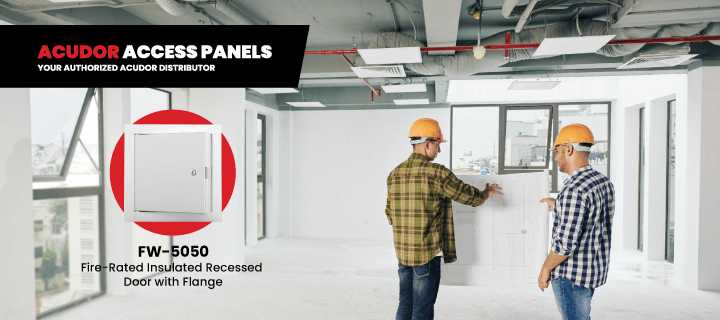
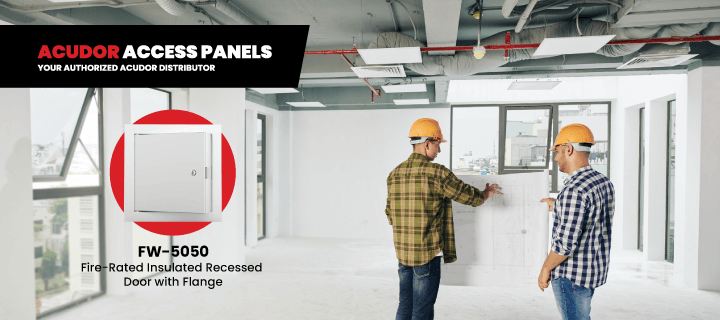
Acudor’s FW-5050 Fire-Rated Insulated Recessed Door with Flange is one of the best access panels that reduce HVAC load, while providing fire protection and reliable access to mechanical and service areas.
Let’s look at its features in detail.
Fire-Rated, Insulated Construction
The FW-5050 pairs energy performance with fire protection in a single insulated assembly. The access door has a 20-gauge steel or stainless steel door and a 16-gauge mounting frame, with the door leaf filled with 2" thick fire-rated insulation.
For walls, the FW-5050 carries a UL 1-1/2-hour “B” label and a ULC 2-hour “B” label, with maximum sizes up to 36" x 48". For ceilings, it is Warnock Hersey International fire-rated for 1 hour in combustible ceilings and 3 hours in non-combustible ceilings, with maximum sizes of up to 24" x 36".
Recessed Flange Design for a Tight Fit
The FW-5050 has a 1" wide flange that supports a clean, recessed installation, which helps control gaps at the perimeter. In addition, the design suits both walls and ceilings where you want a low-profile, finished look without sacrificing performance.
Concealed Hinge and Dependable Operation
The FW-5050 uses a concealed hinge that enhances appearance and helps the door close smoothly and consistently against the frame. Its self-closing and self-latching hardware ensure the panel returns to a secure position after use, which is critical for maintaining energy performance over time.
The universal self-latching bolt can be operated by a knurled knob or flush key. When master keying is required, the door can be prepared for mortise cylinder locks, which makes it easy to integrate with your existing security systems.
Frequently Asked Questions on Insulated Access Doors for HVAC Efficiency
1. How does insulation help reduce energy use?
Insulation reduces energy use by slowing heat flow, so your HVAC system doesn’t have to run as often or as hard. When access doors are insulated, those openings perform more like the surrounding wall or ceiling, which cuts unwanted heat loss or gain and supports more stable indoor temperatures.
2. How can I make my HVAC system more energy efficient?
You can make your HVAC system more energy efficient by tightening the building envelope, improving insulation, and controlling air leakage, especially around mechanical rooms and service openings. Adding insulated, tight-fitting access doors, such as the FW-5050, combined with good maintenance and reasonable setpoints, can also reduce unnecessary HVAC runtime and energy consumption.
3. How does insulation affect building energy consumption?
Insulation lowers building energy consumption by reducing the heating and cooling load your equipment has to handle. When walls, ceilings, and access doors are properly insulated, less heat escapes in winter and less heat enters in summer, which directly translates into lower HVAC energy consumption and operating costs throughout the building's lifespan.
To Sum It Up
Insulated access doors help reduce HVAC loads and save energy by limiting heat transfer and air leakage at service openings. When you choose energy-efficient models, like Acudor’s insulated access panels, you get improved mechanical room efficiency, more stable indoor temperatures, and lower operating costs.
For energy-intensive facilities, Acudor’s FW-5050 Fire-Rated Insulated Recessed Door with Flange puts this into practice by combining insulated, fire-rated construction with reliable service access so you can boost HVAC efficiency without compromising safety or accessibility.
Ready to cut HVAC energy waste? Request a quote for insulated access doors from Acudor, or call +1-888-617-4472 to speak with our specialists about your project.
Acudor Access Panels is a trusted and authorized distributor of Acudor products. We proudly bring you their full range of industry-leading access doors and panels.


